
Physical activity is associated with a lower risk of pre-sarcopenic obesity in adolescents: evidence from Northwest China
Study population
This study was a series of cross-sectional studies conducted in Yinchuan, China, from October 2017 to September 2020. Stratified random cluster sampling was used to select three junior high schools and three senior high schools as samples. After stratification by grade, 13 junior high school classes and 32 senior high school classes were randomly selected. Inclusion criteria: (1) Willing participation in the study and ability to provide required information; (2) General good health with normal physical development, capable of engaging in various physical activities. Exclusion criteria: (1) Age outside the range of 12 to 18 years; (2) Incomplete physical activity data; (3) Presence of current or recent cardiovascular disease, hepatic, renal, or thyroid dysfunction, or ongoing treatment with steroid hormones or thyroid hormone. Ultimately, 2143 subjects were included.
This study was approved by the Ethics Review Committee of Ningxia Medical University (Approval ID: 2016 − 123). Written informed consent was obtained from all participants and/or their legal guardians, confirming that all experiments were performed in accordance with relevant guidelines and regulations.
Assessment of physical activity levels
The International Physical Activity Questionnaire (IPAQ) has been validated as an effective tool for assessing the physical activity levels of adolescents14. This study utilized the IPAQ – Short Form, which consists of seven items. Participants were asked to retrospectively report the duration and frequency of their engagement in three types of physical activities during the previous week: light physical activity (LPA), moderate physical activity (MPA), and vigorous physical activity (VPA). Physical activity levels were expressed in metabolic equivalents (METs), with the METs values for LPA, MPA, and VPA being 3.3, 4.0, and 8.015, respectively16.
$$\begin{gathered} {\text{Total physical activity}}\left[ {{\text{METs}} – {\text{min}}/{\text{week}}} \right] = [{\text{3}}.{\text{3METs}} \times {\text{min}} \times {\text{days}}] + \hfill \\ [{\text{4}}.0{\text{METs}} \times {\text{min}} \times {\text{days}}\left] + \right[{\text{8}}.0{\text{METs}} \times {\text{min}} \times {\text{days}}]. \hfill \\ \end{gathered}$$
The participants were classified into three levels of physical activity based on the IPAQ guidelines: High physical activity (meeting either of the following two criteria): (1) 7 d of walking or moderate or vigorous intensity activities totaling ≥ 3000 MET-min/week; (2) vigorous intensity activity on ≥ 3 d with ≥ 1500 MET-min/week; Moderate activity (any one of the following three criteria) : (1) ≥ 5 d of walking or moderate or vigorous intensity activities totaling ≥ 600 MET-min/week; (2) ≥ 5 d of 30 min of moderate intensity and/or walking per day; (3) ≥ 3 d of 20 min of vigorous activity per day; And low activity (not enough to meet moderate or high activity criteria)17.
Anthropometric measurements
All anthropometric measurements were performed by trained staff using standardized procedures. Height, weight, and waist circumference were measured twice, and the mean value was used for analysis. Measurements were recorded to the nearest 0.1 cm or 0.1 kg. If the two measurements differed by more than 0.5 cm or 0.5 kg, a third measurement was taken to ensure accuracy and minimize technical error18. Body Mass Index (BMI) was calculated as weight (kg) divided by height squared (m²). Body composition analysis and bioelectrical impedance analysis (BIA) were performed using Inbody 370 (Biospace Co., Seoul, Korea), and the skeletal muscle mass (SMM) and fat mass percentage (FMP) were directly read. FMP has always been regarded as an ideal indicator for evaluating body composition. However, BIA is inevitably limited by factors such as the degree of obesity and age, and there may be problems of underestimating or overestimating FMP19
Definition
According to the study by Xu et al.20 the definition of pre-SO combined the low skeletal muscle mass adjusted by weight (SMM/W) and obesity criteria. Low muscle mass was characterized by SMM/W < 1 standard deviation below sex-specific mean values. To ensure the robustness of the criteria, obesity was assessed using three screening standards for adolescents: body mass index (BMI) ≥ 28 kg/m²21; fat mass percentage (FMP) > 20% for boys and FMP > 25% for girls22,23; Waist circumference (WC) ≥ the 90th percentile in each sex and age group24
Covariates
Based on previous research25,26,27, we examined potential confounding factors among demographic characteristics and health-related factors, and ultimately selected age, gender, smoking, drinking status, high-fat food consumption and sleep time as covariates. Smoking was defined as having smoked or attempted to smoke at least once during the past month. Drinking was defined as having consumed alcohol or attempted to consume it during the same period. Sleep time was calculated based on the participants reported going to bed at night and waking up in the morning on school days. High-fat food consumption was defined based on high-fat dietary behaviors reported during the past week, including fried foods, high-sugar foods (such as cakes and chocolates), high-sugar beverages, and poultry meat consumed more than three times per week. If any one of these criteria was met, the individual was classified as having a high-fat diet.
Statistical analysis
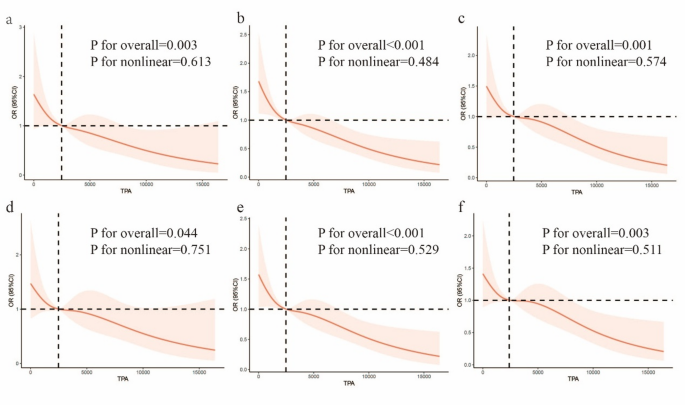
Data were entered using EpiData 3.1 software, and statistical analyses were performed with SPSS 26.0 (SPSS Inc., Chicago, Illinois) and R (version 4.2.2). Normally distributed continuous variables were described as mean (standard) deviation, non-normally distributed data were presented as median (interquartile range), and categorical variables were expressed as percentages. Differences between groups were compared using t-tests, chi-square tests, and rank-sum tests. After adjusting for covariates including age, gender, smoking, drinking status, and sleep time, a binary logistic regression model was employed to analyze the relationship between physical activity levels and pre-SO. The dose-response relationship between physical activity levels and pre-SO was modeled using restricted cubic splines (RCS), followed by stratified analysis. Statistical significance was defined as a two-sided P-value < 0.05.
link


:max_bytes(150000):strip_icc()/A-Physical-Therapist-Shares-the-Most-Underrated-Physical-Activity-94666d193c98412ca90ffbcc23339f90.jpg "Experts Say This Exercise Is the Most Underrated")