
Mapping postpartum physical activity, sedentary time, and sleep: assessing the impact of prenatal physical activity interventions in the FitMum randomized controlled trial
This study mapped PA, sedentary time, and sleep during the first year postpartum and found that PA changes in the postpartum period compared to late pregnancy, with participants achieving more daily steps, less minutes of MVPA and more self-reported PA. That participants took more steps postpartum than in late pregnancy, yet had fewer minutes of daily MVPA, may seem contradictory, but this could be because walking does not necessarily elevate heart rate to MVPA levels. Also, participants slept better at one year postpartum compared to late pregnancy based on self-report. In line with the second aim, we found that the prenatal PA interventions did not influence postpartum PA, sedentary time, or sleep markedly measured by either activity tracker or self-report. Our findings emphasize the importance of mapping PA, sedentary time, and sleep across the perinatal period, as these behaviors collectively impact maternal physical and mental health. Although prenatal PA interventions, such as in the FitMum RCT, improved MVPA, sleep quality, and reduced sedentary time during pregnancy, these effects did not persist postpartum. This gap highlights the need for extended strategies beyond pregnancy to support sustained health behaviors and address postpartum risks like weight retention, poor sleep, and mental health challenges. Our study is unique, as no other study has evaluated the longitudinal effects of prenatal PA interventions on postpartum PA levels, sedentary time, and sleep with both continuous objective measurements and questionnaires.
Postpartum patterns of PA, sedentary time, and sleep
A few observational studies have reported patterns of PA, sedentary time, and sleep from pregnancy and throughout the postpartum period, but the findings are inconsistent. The Pelotas Birth Cohort Study investigated changes in leisure-time PA and sitting time from pregnancy to up to 48 months postpartum using structured interview questions about daily lives and sports participation40. The study revealed that 15.7% of women engaged in leisure-time PA during pregnancy, dropping to 7.9% at 12 months postpartum, and the tendencies of less leisure-time PA postpartum is somewhat similar to our findings, i.e., the decrease in MVPA. In the Pelotas Birth Cohort, the average daily sitting time started at 6.4 h during pregnancy and decreased to between 4.2 and 4.4 h during the first 48 months postpartum. This decline in sitting time is inconsistent with our findings of little change in sedentary time between pregnancy and the postpartum period, maybe due to differences in measurement methods. The proportion of women engaging in any leisure-time walking declined from pregnancy to postpartum in the Pelotas Birth Cohort, which is interesting as the number of steps postpartum surpassed pregnancy levels in our study.
The LIFE-Moms study, which explored maternal movement patterns across pregnancy and postpartum, is another comparable study. The study included data from wrist-worn accelerometers to measure PA, sedentary behavior, and sleep for one week during early pregnancy, one week during late pregnancy, and one week at one year postpartum. In the LIFE-Moms study, sedentary time increased from early to late pregnancy and decreased postpartum, and both light PA and MVPA increased postpartum compared to during pregnancy, which contradicts our findings41. This can be due to several factors, including populations differences (overweight/obese in LIFE-Moms vs. healthy inactive in FitMum), the PA interventions during pregnancy in our study, the use of control data only in LIFE-Moms, and differences in measurement tools (snapshot of actigraphy vs. continuous wrist-worn tracking). The study found that sleep duration decreased from early pregnancy (7.9 ± 0.5 h/day) through late pregnancy (7.6 ± 0.5 h/day) to postpartum (7.2 ± 0.1 h/day), which resembles our findings.
Effect of prenatal PA interventions on postpartum PA and sedentary time
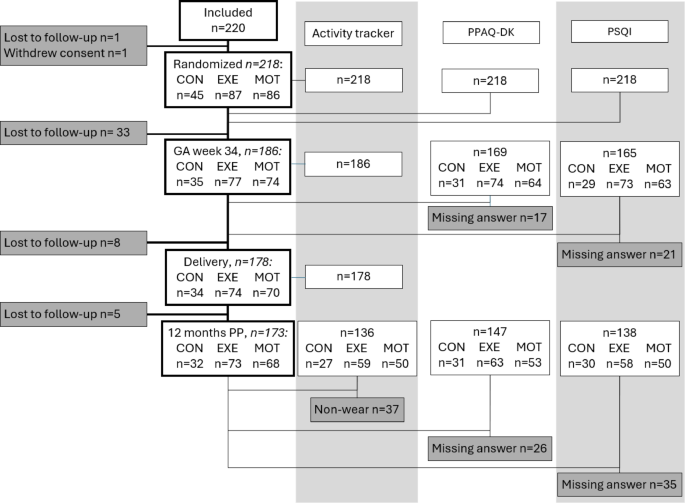
Participants in EXE had been offered structured supervised exercise training throughout pregnancy, and although they did not on average attend half of the sessions, they reported spending significantly more time doing sports during pregnancy than the other two study groups28. However, EXE participants did not maintain sports activities at one year postpartum and differences between groups during pregnancy were not sustained. During pregnancy, offering structured supervised exercise training significantly increased MVPA levels26 and reduced sedentary time27 compared to offering standard care to participants in CON. However, EXE participants did not maintain this difference in the postpartum period. On the contrary, EXE walked fewer steps than CON at six months postpartum, which is difficult to explain, but it may reflect that EXE participants focus on structured exercise over daily activity, e.g. walking. The participants in CON originally signed up for a study investigating PA but did not receive an intervention during pregnancy. All participants were free to engage in PA in the postpartum period, and maybe the motivation of the CON participants was reflected in their step counts postpartum, though they did not report more time spent in light or transportation PA than EXE according to the PPAQ. A relatively high motivation among CON participants was indicated by many women wearing their activity trackers in the postpartum period. Throughout the postpartum year, the average compliance rate for wearing the activity tracker was 41% in CON (EXE: 35%, MOT 32%) suggesting generally high motivation to engage in PA.
The GeliS cluster-randomized trial performed face-to-face counseling sessions during pregnancy to encourage pregnant women to eat a healthy diet and increase their PA and analyzed health behavior 6–8 weeks and one year postpartum using PPAQ22. In accordance with our findings, no differences between study groups were found at 6–8 weeks and one year postpartum. Another study examined the impact of a prenatal lifestyle intervention on PA levels in late pregnancy and up to one year postpartum and found that while the intervention significantly increased PA levels at GA 36 weeks, no significant differences between groups were present at one year postpartum23. Therefore, PA interventions during pregnancy can increase the activity level of pregnant women, but increased PA apparently does not carry over to the postpartum period.
Effects of prenatal PA interventions on postpartum sleep
A recent systematic review and meta-analysis revealed that exercise interventions postpartum significantly improved sleep quality and reduced daytime fatigue compared to no exercise42. However, we did not identify any studies that implemented lifestyle interventions from early pregnancy until delivery and subsequently conducted follow-up studies to observe the effects of prenatal PA interventions on postpartum sleep. In the FitMum RCT, we found that sleep quality, as measured by the PSQI, was better for participants in the EXE group compared to CON at GA week 28, and both EXE and MOT showed better sleep outcomes than CON by GA week 34. Despite the self-reported improvements in sleep quality, activity tracker data revealed no significant differences between study groups in terms of sleep duration during pregnancy27. In the present study, sleep continued to decline to one year postpartum. On the other hand, participants self-reported improved sleep quality and fewer sleep disturbances at one year postpartum compared to late pregnancy. These findings underscore the importance of distinguishing between sleep quantity and quality. This suggests that while prenatal interventions may benefit perceived sleep during pregnancy, they may not be sufficient to sustain objective improvements postpartum, which are influenced by unique physiological demands, caregiving responsibilities, and psychosocial factors. The mechanisms linking PA and sleep remain not fully understood, but PA may enhance sleep through hormonal, thermoregulatory, and neurological pathways, as well as by regulating circadian rhythms, which together promote relaxation and improve sleep timing and quality43,44. Moderate-intensity, structured PA performed 1–3 times per week has also been shown to improve sleep quality during pregnancy45,46,47.
Strengths and limitations
To the best of our knowledge, no other randomized controlled study has examined PA levels, sedentary time, and sleep from early pregnancy through delivery to one year postpartum with both objective and subjective methods. A strength of this study is the continuous measurement by the activity tracker from delivery to one year postpartum, which gives a better reflection of health behaviors than shorter measurements at specific timepoints. A limitation of this study is that measurements of steps from a wrist worn accelerometer might not be accurate, as steps are recorded less precisely when keeping the wrist stable, for example, when pushing a stroller. This may have affected the number of steps obtained in all three study groups. This study tracks physical behaviors across major life transitions (pregnancy, postpartum, parenthood), which are accompanied by changes in work status and likely also in sleep. These factors may influence behavior through shifting internal standards (e.g., adapting to less sleep), rather than through intentional behavior change. Furthermore, this study was powered to investigate PA outcomes until GA week 28; thus, later dropout rates could affect the robustness of the statistical models. The inclusion of healthy, inactive, Danish women may limit the generalizability of our findings to more diverse or international populations. Also, the PPAQ was designed for pregnant women, not postpartum, but we wanted to use the same instrument at postpartum for comparability. Future studies are needed to map the timing and type of interventions to support and sustain postpartum maternal health13. Moreover, studies should apply longitudinal designs that track PA, sedentary behavior, and sleep from early pregnancy to the postpartum period. Lastly, we acknowledge the lack of data on postpartum PA barriers as a limitation and recommend addressing this in future research.
link


:max_bytes(150000):strip_icc()/A-Physical-Therapist-Shares-the-Most-Underrated-Physical-Activity-94666d193c98412ca90ffbcc23339f90.jpg "Experts Say This Exercise Is the Most Underrated")