
Long-lasting effects of pregnancy and childbirth on physical activity in early school-age children
The study group consisted of 207 mothers of school-aged children, along with their children.
The characteristics of the study group are presented in Table 1.
In the present study, the PAQ-A questionnaire was used to assess physical activity in a group of school children. Descriptive statistics for the children’s physical activity levels are presented in Table 2. On this scale, the study group scored between 1.00 and 4.61 points, with a mean of 2.95 points and a standard deviation of ± 0.73 points. Half of the children had scores of up to 2.99 points on this scale. Analysis with the Shapiro-Wilk test showed that the distribution of physical activity was not statistically significantly different from normal distribution (p = 0.057), but this result was on the borderline of statistical tendency. The distribution of results was somewhat concentrated around the mean and had observations that were slightly outliers with low levels of physical activity.
Based on the children’s scores for the PAQ physical activity questionnaire, the children were divided according to their level of physical activity:
-
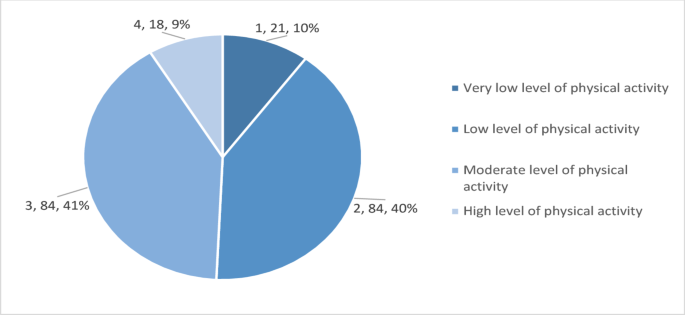
Very low activity level (1.00–1.99 points): 10.1% of children;
-
Low activity level (2.00–2.99 points): 40.6% of children;
-
Moderate level of activity (3.00–3.99 points): 40.6% of children;
-
High level of activity (4.00–5.00 points): 8.7% of children.
The distribution of children’s physical activity levels, assessed using the PAQ-A, is presented in Fig. 1.

Distribution of children’s physical activity levels based on the PAQ-A.
The distribution of physical activity levels among the surveyed children was proportional, with a similar proportion of children having low or very low activity in relation to the proportion of children with moderate and high levels of physical activity.
In order to verify the presence of an association between the child’s physical activity and mother’s age at delivery, Spearman’s rho correlation analysis was performed, which yielded a statistically insignificant result: rho = 0.03; p = 0.683, meaning that no association between the child’s physical activity level and mother’s age at delivery could be inferred. Subsequently, there were also no statistically significant associations between the child’s physical activity level and the child’s birth mass based on a statistically insignificant Kendall tau correlation score tau = 0.04; p = 0.417.
It was also investigated whether there was a statistically significant difference between the child’s physical activity and the mother’s prevalence of chronic diseases, supplementation during pregnancy, cigarette smoking, maternal physical activity during pregnancy, onset and termination of labour, occurrence of complications during labour, health problems in the child after delivery and ICU stay. For this purpose, a series of comparative analyses were performed using the Mann-Whitney U-test. The level of physical activity in children was not statistically significantly different for: use of supplementation during pregnancy (Z = 1.50, p = 0.133, r = 0.10); smoking during pregnancy (Z = 0.00, p = 0.996, r = 0.00); method of pregnancy termination (Z = 1.58, p = 0.114, r = 0.11); induction of labour (Z = 0.58, p = 0.559, r = 0.04); complications during childbirth (Z = 1.26, p = 0.207, r = 0.09); complications of the neonatal period (Z = 1.65, p = 0.099, r = 0.11); and the baby’s stay in the NICU (Z = 1.89, p = 0.058, r = 0.13) (result at the limit of statistical trend).
In contrast, activity levels in the children were shown to be statistically significantly differentiated by the mother’s chronic diseases (Z = 2.59, p < 0.01, r = 0.18) and the mother’s physical activity during pregnancy (Z = 2.37, p < 0.01, r = 0.16). Higher physical activity levels were shown in children whose mothers did not have chronic diseases and were physically active during pregnancy.
The Kruskal-Wallis test was performed to verify whether children’s physical activity levels were differentiated by week of pregnancy and duration of delivery. The results of these analyses showed that there was no statistically significant association of child physical activity with week of delivery: χ = 3.46, p = 0.177, η = 0.01; or duration of delivery: χ = 2.03, p = 0.363, η = 0.00.
During the next step, the existence of an association between children’s physical activity level measured on a nominal scale (low and high physical activity) and all the variables analysed in the study were verified. For this purpose, a series of analyses were performed with Pearson’s χ tests. The results of these analyses showed that there were no statistically significant differences between the child’s physical activity level and the mother’s age at the time of the child’s birth: χ = 3.66, p = 0.300, V = 0.13; the mother’s smoking during pregnancy: χ = 0.00, p = 0.959, V = 0.00; the week of pregnancy when the birth occurred: χ = 1.30, p = 0.521, V = 0.08; induction of labour: χ = 0.54, p = 0.464, V = 0.05; duration of labour: χ = 0.48, p = 0.787, V = 0.05; occurrence of complications during labour: χ = 2.51, p = 0.113, V = 0.11; birth mass of the baby: χ = 1.21, p = 0.877, V = 0.08; health problems in the child after birth: χ = 0.76, p = 0.382, V = 0.06; and the child’s stay in the NICU: χ = 0.98, p = 0.323, V = 0.07.
In contrast, the children’s physical activity level showed a statistically significant difference regarding the mother’s chronic diseases: χ = 7.60, p < 0.01, V = 0.19; the use of supplementation during pregnancy: χ = 4.48, p < 0.05, V = 0.15; maternal physical activity during pregnancy: χ = 8.52, p < 0.05, V = 0.20; and mode of delivery: χ = 5.65, p < 0.05, V = 0.17. High levels of physical activity were more common in children whose mothers had no chronic diseases, did not use supplements during pregnancy and were physically active during pregnancy and in children born by natural delivery.
Logistic regression analysis was performed to identify predictors of high physical activity in children. A backward elimination method was used to leave variables in the model that were statistically significant predictors of high physical activity. The quantitative variable of age and other variables were included in the model as nominal variables (chronic diseases, supplementation, smoking, complications during pregnancy, complications of the neonatal period in the child, being in the NICU—no/yes, physical activity during pregnancy – no, sometimes/several times a week, termination of labour – natural/caesarean section, delivery duration – up to 6 h/more than 6 h, Child’s birth mass – up to 3.5 kg/more than 3.5 kg).
The logistic regression model obtained was found to be statistically significant χ(4) = 19.90; p < 0.01, which means that the variables obtained in the model can statistically significantly predict high levels of physical activity in children. The Hosmer Lemeshow goodness-of-fit test was found to be statistically insignificant χ(8) = 3.71; p = 0.882, meaning that there is no basis to reject the null hypothesis suggesting the predicted distribution obtained with the model does not differ from the distribution observed in the sample. Nagelkerke’s coefficient of determination R was R = 0.117, which means that the variation in children’s physical activity levels was 11.7% explained by the variables in the model. Regression analysis using the Wald elimination method showed that predictors of high physical activity in children in the study group were the presence of chronic diseases in the mother: W = 4.84, p < 0.05, Exp(B) = 0.52; dietary supplementation during pregnancy: W = 3.86, p < 0.05, Exp(B) = 0.53; mode of delivery: W = 2.88, p = 0.089, Exp(B) = 0.56 (result at the limit of statistical trend); and maternal activity during pregnancy: W = 3.51, p = 0.061, Exp(B) = 1.90 (result at the limit of statistical trend). From the odds ratio results, it can be deduced that the presence of chronic diseases in pregnant women reduced the chance of a high level of physical activity in the child by about half (48%) (Exp(B) = 0.52). Also, vitamin supplementation during pregnancy reduced the chance of high levels of physical activity in the child by about half (47%) (Exp(B) = 0.53). The chance of a high level of physical activity in the child was also reduced by 44% (Exp(B) = 0.56) in the case of termination of labour by caesarean section compared to natural deliveries. Physical activity performed at least twice a week was also shown to increase the chance of a high level of physical activity in the baby by 90% (Exp(B) = 0.90). These results are presented in Table 3.
Physical activity levels were dichotomised as low (≤ 3.0 points on the physical activity scale) and high (> 3.0 points). The initial regression model included the following predictors: mother’s age at delivery, chronic diseases, dietary supplementation during pregnancy, smoking during pregnancy, gestational week at delivery, mode of delivery, spontaneous vs. induced labour, duration of labour, labour complications, birth weight, child’s health problems, neonatal intensive care unit stay, and maternal physical activity during pregnancy. The child’s sex and age were not included, as the aim of the analysis was to examine the influence of pregnancy-related factors on children’s physical activity.
Variables not shown in the table were included in the initial model but were excluded in the final step due to lack of statistical significance.
Classification accuracy was based on the dichotomised activity levels described in Table 4. The logistic regression model correctly classified 62.3% of cases overall, including 78.4% of children with high physical activity and 46.7% of children with low physical activity.
link


:max_bytes(150000):strip_icc()/A-Physical-Therapist-Shares-the-Most-Underrated-Physical-Activity-94666d193c98412ca90ffbcc23339f90.jpg "Experts Say This Exercise Is the Most Underrated")