Chain relationship between cumulative ecological risk and physical activity pattern on college students mediated by exercise atmosphere and self-control
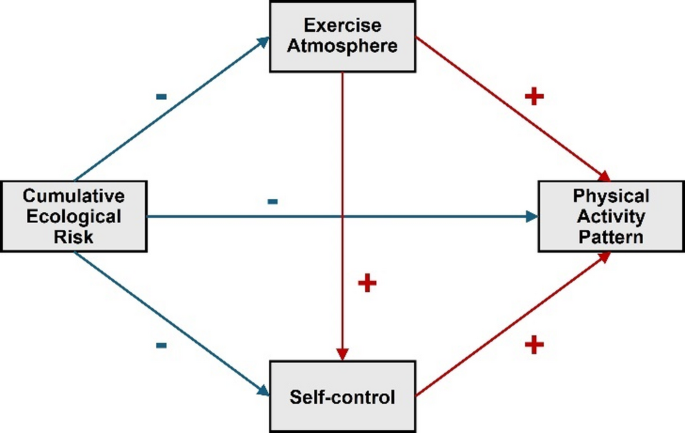
PAP is an important part of students’ healthy lifestyles and refers to the way in which individuals promote their physiological and psychological health through daily PA. A good PAP increases students’ motivation to exercise, enhances their recognition of the value of exercise, and strengthens their motivation to continue exercising24. In addition, parents’ beliefs about sport and school sport resources positively influence students’ sporting behavior. In line with the herd mentality, positive PAP encourages students to imitate the sporting habits of their peers, increases social support and sporting friendships, and fosters the development of a healthy sporting lifestyle25. In our study, both PAP and SC served as mediators between CER and students’ EA. Meanwhile, there was a significant relationship between PAP and students’ SC. Positive PAP creates an environment in which individuals monitor and support each other, which effectively improves individual SC. Therefore, this study investigates whether PAP and SC can mitigate the negative effects of CER on PAP.
The negative impact of cumulative ecological risk on college students’ sporting lifestyle and improvement measures
The first finding of this study is that CER negatively influences college students’ sporting lifestyle, a process shaped by multiple environmental and individual factors such as family, peers, community, and SC. When the CER factor is small, the school, family, and society generally provide a favorable sports environment and sufficient facilities, which facilitate students’ participation in PA26. The scientific planning of community facilities ensures convenience for exercise, schools promote activities and clubs through various systems, and parents’ strong awareness of exercise fosters positive imitation in students’ EAs. Parents not only provide equipment but also exercise with their children and supervise health behaviors, which promotes the development of healthy lifestyles27. Peer support also plays an important role, influencing students’ choice and adherence to sporting programs, while school leaders’ emphasis on PA, the activity of clubs, and the overall culture provide organizational support for forming stable exercise habits28. Furthermore, the accessibility of school and community facilities, together with a supportive green environment, attract students to actively engage in outdoor PA29. By contrast, when the CER factor is high, the absence of these resources exposes individuals to ecological adversity. Insufficient SC and coping efficacy make it harder to adopt healthy lifestyles30. Under such conditions, college students lack adequate sports facilities, well-maintained equipment, and effective planning or management of spaces, while accessibility to PA opportunities is also restricted. These barriers hinder the formation of a PA lifestyle and reinforce the negative impact of ecological risk31.
The moderating and mediating effects of exercise atmosphere on the relationship between cumulative ecological risk and physical activity patterns
The second finding of this study was that PAP partially mediated the pathway between CER and college students’ EA. When college students are in an environment with less CER, a good exercise environment and harmonious interpersonal support constitute important conditions for the formation of their EAs32. Regarding the exercise environment, schools increase investment in sports funding, optimize the supply of school sports resources, and place simple and practical sports equipment in living areas, libraries, dormitories, classrooms, and other spaces33. Schools make full use of existing sports grounds and facilities, strengthen their planning, scientifically plan gyms in dormitory and residential areas, extend the opening hours of existing gyms, and assign sports instructors to guide students, thereby improving the convenience of fitness activities. The school’s official website and various social platforms promote the value of sports and health, recommend sports and health knowledge and skills, and guide students to actively integrate sports into daily life34. The community sports environment and services also play an important role in shaping students’ EAs. The provision and accessibility of community sports facilities and equipment, the development of sports clubs, the promotion of health knowledge through the media, regular sports and health forums organized by the community, and community fun activities and family sports gatherings create a supportive sports environment, attracting students to maintain regular exercise and forming healthy lifestyles35. A good sports environment fosters a favorable PAP for students. Within this environment, parents encourage and continuously motivate students to adhere to physical exercise to improve their health, while physical education teachers focus on cultivating students’ sports literacy and values, which contributes to the formation of a healthy lifestyle36.
The mitigating effect of exercise atmosphere on cumulative ecological risk and the direction of school reform
The third finding of this study is that when college students are in environments with low CER, schools and communities provide safer, more convenient, and more accessible facilities, which increase supportive resources for individual exercise. Peers also form a PAP of mutual supervision and encouragement, and students are more likely to engage in healthy PA when they actively seek support from teachers and peers. Such peer interactions help maintain good interpersonal relationships, encourage participation, and reduce undesirable behaviors37. According to Bandura’s social learning theory, peer modeling plays an important role in shaping exercise habits38. Moreover, supportive environments and peer relationships replenish attentional resources, and exercising with peers creates a mutually supervised context that enhances SC. Individuals with higher SC can focus on the value of PA, maintain persistence, and consciously inhibit impulsive behaviors39. They also show better self-management, stronger emotion regulation, and greater alignment with social norms, which facilitates the formation of a healthy sporting lifestyle40. In contrast, high CER reflects a lack of supportive resources. Without adequate support from family, school, and peers, students are more likely to seek compensation in other environments, which hinders the development of a healthy lifestyle41. Furthermore, when PA environments are poorly organized, and supervision from parents and peers is limited, students’ SC skills are less likely to develop, making them more prone to withdrawal and procrastination when facing challenges, ultimately obstructing the formation of a healthy PA lifestyle42.
Possible reasons for cumulative ecological risk affecting students’ physical activity patterns
For the above phenomenon, this study speculates several possible reasons. During physical exercise, with the reduction of cumulative risks in the family, school, and community, college students demonstrate a higher level of cognition regarding the value and function of PA. Along with gradual improvements and rational layout of sports facilities and fitness equipment, accessible opening hours and well-maintained equipment enhance students’ satisfaction with the exercise environment42. Students are influenced by parents’ positive views of sport and by peer support, which encourages relaxation and enjoyment during exercise and promotes engagement with peers who share similar interests. Parents and peers provide supportive resources for individual PA and form a PAP for mutual supervision of shared PA43. A favorable PAP offers an emotional and environmental protective field for sustained health behavior. It mobilizes SC, allowing students to adopt a positive and optimistic attitude when facing exercise barriers, consciously eliminate disturbances unrelated to exercise, actively engage in established tasks, and maintain good exercise habits44. A supportive environmental and interpersonal atmosphere provides incentives for independent participation, enhances self-control, and helps individuals integrate into collective environments and develop interpersonal relationships through sports. In contrast, when PAP is poor, community and school sports facilities and fitness equipment cannot meet exercise needs45. Additionally, without emotional support from parents and peers, students’ exercise self-control decreases, leading to disorganized, individualized exercise behaviors and interruptions in exercise routines, which hinders the development of a healthy physical lifestyle46.
In conclusion, CER is significantly negatively correlated with PAP, SC, and college students’ EA. CER directly predicts a negative effect on college students’ EA and indirectly predicts it through the mediating effects of PAP and SC. These findings align with motivational theories emphasizing the role of the environment and self-regulatory capacities in fostering exercise motivation. Notably, Ahmadi proposed a comprehensive classification system of motivational behaviors grounded in Self-Determination Theory, providing a valuable framework for understanding and enhancing motivational interventions aimed at increasing physical activity47. Therefore, families, schools, and society should provide college students with a supportive exercise environment and positive interpersonal support, leveraging both online and offline sports activities to encourage physical exercise48. Attention should be given to the encouragement and supervision roles of parents, teachers, and peers, while simultaneously enhancing individuals’ self-control to facilitate the development of a healthy exercise atmosphere among college students49.
From a practical perspective, universities and communities can enhance students’ physical activity by improving access to sports facilities, creating supportive social environments, and offering structured opportunities for engagement. Faculty, peers, and community programs can provide encouragement and guidance, reinforcing positive exercise behaviors. By combining environmental support, social reinforcement, and strategies that strengthen self-control, these measures can help students develop sustainable exercise habits and promote long-term physical and mental well-being.
Limitations and suggestions for future research
This study aims to explore the influence of CER on PAP among college students, focusing on the chain mediation effects of EA and SC. Using a structural equation model, the study reveals how social environments, and psychological mechanisms influence exercise behavior patterns, providing theoretical support for health behavior change. Ultimately, the goal is to promote the extension of university physical education toward community-based and lifestyle-oriented approaches. This approach fosters the development of stable and positive physical activity Habits among college students in their daily lives and lays the foundation for cultivating long-term healthy lifestyles. Consequently, a cross-sectional large-sample survey was conducted, encompassing 966 college students in Beijing, with the objective of analyzing the dosage characteristics of EA and SC in improving college students’ PAP with CER as the main variable. Nevertheless, it should be noted that this study is not without limitations.
Firstly, although four indicators are included in this study to facilitate comparison between populations, the experimental design was a cross-sectional survey with no longitudinal follow-up. In examining previous large-sample surveys, it becomes evident that some studies have employed a screening process using the NHANES, SEER, and CHARLS databases, standardizing the indicators through the application of the Weighted Mean Difference (WMD) methodology and subsequently conducting sequential comparisons. This approach offers the advantage of expanding sample size while incorporating parameters from longitudinal interventions. However, it also has the disadvantage of reducing the originality of the original research. Instead of searching previous databases, a cross-sectional sample was included and compared over a period of approximately one year. It is therefore the intention of this study to highlight its originality, although it must be acknowledged that the results may be open to question due to certain limitations.
Secondly, the purpose of this study is to explore the chain relationship between CER, PAP, and SC in order to predict the optimal psychological path for promoting PA among students and guide campus construction reforms. This study employed the Physical Activity Pattern Scale for College Students developed by Wang et al., which focuses on assessing the patterns and subjective experience of physical activity (e.g., regularity, intensity perception, and emotional engagement), rather than documenting specific exercise types such as cycling, walking, or swimming. As a result, detailed information about participants’ specific sports activities was not collected, which constitutes a limitation of the current research. Moreover, given the large sample size, collecting individual-level exercise data with high specificity is methodologically challenging in cross-sectional designs. More precise information about exercise characteristics can be better captured in future longitudinal or interventional studies, where closer behavioral monitoring is feasible.
Finally, the findings of this study should be interpreted with caution due to potential limitations in sampling generalizability. All participants were recruited from universities in Beijing, which may introduce regional or cultural biases affecting students’ physical activity patterns, self-control capacities, and perceptions of exercise atmosphere. These contextual factors could limit the applicability of the results to other populations. Additionally, the cross-sectional nature of the study restricts the ability to draw causal conclusions. Future research would benefit from longitudinal tracking or experimental designs to clarify the temporal relationships among CER, SC, EA, and PAP. Incorporating targeted interventions aimed at enhancing SC or optimizing EA may also help determine effective strategies for promoting sustainable behavioral change in physical activity engagement.
While the aforementioned issues cannot be overlooked, this study endeavored to minimize the heterogeneity of results caused by the experimental design within the limited experimental conditions by employing techniques such as Bootstrap and Bonferroni. Furthermore, future studies will analyze longitudinal results, PA volume, and gender differences, and re-adjust the core focus of the study. In light of the current findings, efforts will be made to enhance the reliability and rigor of the study. The objective is to provide college students with efficacious exercise prescriptions to improve problematic behaviors and promote mental health.
link

:max_bytes(150000):strip_icc()/A-Physical-Therapist-Shares-the-Most-Underrated-Physical-Activity-94666d193c98412ca90ffbcc23339f90.jpg "Experts Say This Exercise Is the Most Underrated")