
Predictive model of the relationship between social support, body image perception, and physical activity among university students
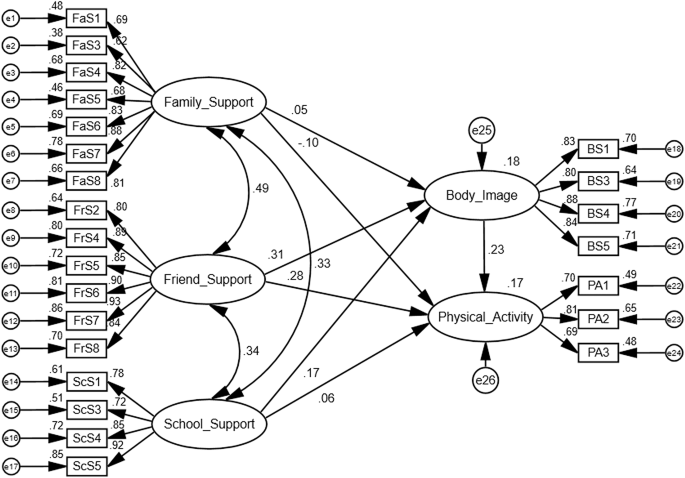
In modern society, insufficient physical activity among university students has become a significant public health concern (Bull et al. 2020). Despite the well-established benefits of physical activity, including enhanced cardiovascular function, increased muscle strength, and improved mental health (Bull et al. 2020), approximately 80% of adolescents worldwide do not meet the World Health Organization recommendations of at least 150 min of moderate-intensity or 75 min of vigorous-intensity aerobic activity per week (Hallal et al. 2012). According to 2022 Chinese health statistics, there are 42 million university students in China, and 55% of these students do not meet the recommended exercise guidelines of 30–60 min per day, 3–5 days per week (Daily, 2020). Although university students report favorable intentions to engage in physical activity, they encounter several barriers, including a lack of social support (Deliens et al. 2015; Kwan and Faulkner, 2011).
Physical activity is a complex behavior influenced by personal, social, and environmental factors (Spence and Lee, 2003). While many previous studies have explored the relationship between personal factors (e.g., self-efficacy and motivation) and physical activity, there has been relatively less focus on the relationship between social factors and physical activity (Craggs et al. 2011). According to social cognitive theory, social support is a crucial determinant of physical activity (Bandura, 2004), influencing the decisions individuals make about engaging in physical activity (Yang et al. 2014). For university students, social support primarily encompasses family, friends, and school support (Chen et al. 2016).
Family, friends, and school support play a crucial role in promoting physical activity among university students (Chen et al. 2016). Evidence suggests that parental support can encourage students to engage more in physical activity, helping them develop positive attitudes and values towards physical activity and motivating them to participate actively (Shen et al. 2018). For example, parents who are actively involved in physical activities themselves or provide necessary equipment and transportation can significantly enhance their children’s levels of physical activity (Beets et al. 2010). This support helps establish a foundation for an active lifestyle that extends from adolescence into adulthood. As university students mature, friend support becomes more important than family support (Prochaska et al. 2002). Friends and peers can provide companionship, motivation, and positive reinforcement, which are essential for maintaining regular physical activity (Duncan et al. 2005). Participating in physical activities with friends can make exercise more enjoyable and socially rewarding, thereby increasing the likelihood of sustained participation (Maturo and Cunningham, 2013). School support is also a vital factor in promoting physical activity among university students (Babey et al. 2016). Educational institutions can facilitate physical activity by providing sports facilities, organizing sports activities, and offering encouragement from teachers and coaches (Durant et al. 2009). Universities that offer well-maintained sports facilities and a variety of physical activity programs can significantly enhance students’ opportunities to engage in exercise (Durant et al. 2009). Additionally, positive reinforcement and support from teachers and coaches can motivate students to participate in and maintain regular physical activity routines (Pluta et al. 2020). In considering previous studies on social support and physical activity, it appears that family, friends, and school support can significantly increase physical activity levels among university students and promote the development of healthy lifestyle habits. However, studies that simultaneously examine the relationships and differences between these three types of support and physical activity remain relatively scarce. Therefore, this study is designed to comprehensively examine the relationships between family, friends, and school support and physical activity among university students.
University students, particularly those in adolescence, often place significant focus on their body image (Grossbard et al. 2009). Body image perception is defined as an individual’s subjective perception and attitude toward their physical appearance (Cash et al. 2004). This perception plays a crucial role in influencing physical activity (Jensen and Steele, 2009). Evidence suggests that individuals with a positive body image perception are more likely to engage in physical activities because they feel confident and comfortable displaying their bodies in public (Olchowska-Kotala and Chromik, 2013). Conversely, those with a negative body image perception may feel dissatisfied with their body image, leading them to avoid social and physical activities (Añez et al. 2018). A positive body image not only enhances self-confidence but also increases interest and participation in physical activities, creating a positive feedback loop that promotes overall health (Cash et al. 2004). Therefore, improving body image is crucial for encouraging university students to participate in physical activities and enhancing their health.
Although many different factors influence university students’ body image perception, social support is a critical factor as social relationships play a formative role in shaping attitudes and values toward the body (Cash and Smolak, 2011). Family and friend support are key in this regard. Parents’ attitudes, dietary and weight control suggestions, and potential teasing can directly influence their children’s body image perception (Dell’Osbel et al. 2021; Kluck, 2010; Schaefer and Salafia, 2014). Positive interactions and acceptance from friends can enhance self-esteem and body satisfaction, while negative feedback or comparisons may lead to body dissatisfaction (Gerner and Wilson, 2005; Hutchinson and Rapee, 2007). Additionally, school support influences students’ body image perception through health education programs, the provision of sports facilities, and the promotion of body positivity and inclusivity (Fernandes and Sturm, 2010; Yager et al. 2013). However, current research exploring the relationship between social support and body image is limited. Therefore, further investigation into this relationship is crucial for understanding and improving university students’ body image perception.
In view of the above, it is understood that social support and body image perception are significant predictors of physical activity among university students. Furthermore, body image perception is related to both social support and physical activity, indicating that body image may mediate the relationship between social support and physical activity. However, the interrelationships among social support, body image perception, and physical activity have not been thoroughly explored. This warrants further exploration to better understand how various forms of social support influence physical activity through body image perception.
Theoretical framework
This study adopts social cognitive theory (Bandura, 2004) and body image theory (Cash and Smolak, 2011) to explore the relationships between social support, body image perception, and physical activity among university students. Social cognitive theory emphasizes the reciprocal interaction between personal, behavioral, and environmental factors, where social support is a key environmental factor that influences physical activity. Social support, encompassing family, peer, and school support, directly affects physical activity by providing emotional, informational, and tangible resources (Chen et al. 2016). Beyond this direct effect, social support influences physical activity through outcome expectations, a core component of social cognitive theory. Body image perception is conceptualized as an outcome expectation—individuals who perceive their body positively are more likely to engage in physical activity, as they feel more confident and comfortable with their appearance. According to body image theory, individuals with positive body image perceptions are more likely to engage in physical activity, as they anticipate improved appearance and self-esteem as outcomes (Cash and Smolak, 2011). Conversely, negative body image perceptions may act as a barrier, discouraging physical activity due to feelings of self-consciousness or dissatisfaction with one’s body (Tylka & Subich, 2002). This study posits that body image perception mediates the relationship between social support and physical activity, with social support enhancing body image perception, which in turn increases the likelihood of engaging in physical activity. By combining social cognitive theory and body image theory, this framework illustrates how social support and body image perception work together to influence physical activity behavior among university students. However, the lack of research examining the role of different types of social support (family, friends, and school) in influencing physical activity through body image perception highlights the need for further investigation, which will be analyzed within this paper.
Literature review
In exploring the relationship between social support and physical activity, with the mediating role of body image perception, existing studies were reviewed to establish the theoretical foundation and understanding the interplay between these variables, also breaking down the hypotheses of the study.
Relations between social support and physical activity
A 2024 systematic review by Wang et al. encompassing 19 studies, investigated the association between social support and physical activity among university students, revealing a significant positive relationship. Among the types of support examined, peer support demonstrated a stronger correlation with physical activity levels than family support (r = 0.27 vs. r = 0.14), possibly reflecting the greater reliance of university students on peer engagement and companionship during their transition to independent living. Nevertheless, family support remains vital in providing emotional reinforcement and material resources, particularly in fostering long-term exercise habits. Although the review underscored the general importance of social support, it did not explore the role of school support in depth. For university students who predominantly reside on campus, school support may represent a critical and unique factor in promoting physical activity. Evidence suggests that school support fosters physical activity by enhancing students’ sense of belonging and motivation. For instance, Babey et al. (2016) found that when students felt cared for and encouraged by teachers or school staff, physical activity levels significantly increased, particularly among low-income and minority groups, during recess and after-school periods. Similarly, Durant et al. (2009) highlighted the importance of adequate facilities (e.g., playgrounds, fitness equipment) and supportive policies (e.g., increased physical education hours and recess opportunities) in facilitating higher levels of physical activity. Pluta et al. (2020) further emphasized the role of physical education teachers in promoting moderate-to-vigorous physical activity, while parental emotional support and peer involvement also played critical roles in enhancing students’ overall participation. Collectively, these findings demonstrate that family, peer, and school support each contribute significantly to the promotion of physical activity. This study hypothesizes that all three forms of social support positively influence university students’ physical activity levels, with the relative strength of their impacts remaining a question for further investigation.
Social support, body image perception, and physical activity
While the relationship between social support and physical activity is well-documented, the mediating role of body image perception remains underexplored. Evidence suggests that social support positively influences body image perception, which in turn enhances physical activity, pointing to a potential mediating mechanism. For example, Dell’Osbel et al. (2021) showed that parental support significantly shapes adolescents’ body image, with positive behaviors like emotional encouragement and the promotion of healthy lifestyles improving body satisfaction, while excessive focus on appearance exacerbates body dissatisfaction. Similarly, Kluck (2010) found that a supportive family environment—characterized by reduced appearance-based criticism and increased positive reinforcement—helps adolescents develop healthier body perceptions and self-esteem, reducing body image dissatisfaction. Furthermore, body image perception is strongly associated with physical activity. Two meta-analyses (Babic et al. 2014; Bassett-Gunter et al. 2017) reported a significant positive correlation between body image perception and physical activity, particularly in structured and high-intensity exercises, where individuals with more positive body perceptions were more likely to engage in physical activity. Given these findings, this study hypothesizes that body image perception mediates the relationship between social support and physical activity among university students.
The present study
This study aimed to investigate the relationships among different types of social support, body image perception, and physical activity. Specifically, it was hypothesized that (a) family, friends, and school support, along with body image perception, would prospectively predict physical activity; and (b) family, friends, and school support indirectly influence physical activity through the mediation of body image perception.
link

:max_bytes(150000):strip_icc()/A-Physical-Therapist-Shares-the-Most-Underrated-Physical-Activity-94666d193c98412ca90ffbcc23339f90.jpg "Experts Say This Exercise Is the Most Underrated")