
Validation of physical activity recall questionnaire and log using doubly-labelled water in Sri Lankan children
Study participants, selection and study design
A purposive sample of 96 children aged 11–13 years were recruited from the Colombo Municipal Council area. The study was designed and conducted according to the Helsinki Declaration. Informed written consent from parents and assent from children were obtained. The Ethics Review Committee of the Faculty of Medicine, University of Colombo, Sri Lanka (EC/16/192) approved the study. A total of 16 children free of any acute or chronic medical conditions or prolonged use of medication, were recruited from each age group (11, 12 and 13 years) according to the national distribution of nutritional status. Details of the study design and method of participant selection and recruitment are published elsewhere [6, 7].
Measurements
Anthropometric measurements
Height and weight were measured according to the International Society for the Advancement of Kinanthropometry protocol [8] using a stadiometer (Seca 225 by SECA GmbH & Co. Kg., Hamburg, Germany) and a calibrated electronic scale (Seca 803 by SECA GmbH & Co. Kg., Hamburg, Germany), respectively. BMI was calculated as weight divided by height squared (kg/m2).
DLW technique for TEE calculation
The two-point DLW protocol was used according to the International Atomic Energy Agency protocol (IAEA) [5]. A weighted mixture of 0.12 g.kg−1 body water of 99.8% 2H2O and 1.8 g.kg−1 body water of 10% H218O (Sigma-Aldrich Co., St. Louis, MO, USA) was used as the DLW dose [5]. Prior to administering the DLW dose on the dosing day (Day 1), a baseline urine sample was taken. The first post-dose urine sample was taken four hours after the dose was administered. The last urine sample was taken on day 10 at the same time as the first urine sample after the dosing, which was taken four hours after the dose on day 1. Before analysis, all samples were kept in storage at -20°C. Further, details of the DLW procedure, including dose preparation, dosing, sample collection, sample storage, analysis and calculation of energy expenditure are published elsewhere [6, 7].
Urine samples were analyzed at the Mass Spectrometry Laboratory, St. John’s Research Institute, Bangalore, India using isotope-ratio mass spectrometry (IRMS, Delta V Advantage, Thermo Scientific, Bremen, Germany). Total body water (TBW) was estimated and lean body mass (FFM) derived from the TBW value. According to the two-compartment model of body composition assessment, the body weight is comprised of FM and FFM. FFM was estimated from the corrected TBW using the hydration coefficient [5]. The hydration coefficient among the children was calculated using the age-specific hydration constants [9]. Assuming a 2-compartment model, FFM was subtracted from total body weight to calculate fat mass (FM). The rate of carbon dioxide production was calculated by the difference in the 2H and 18O turn-over rates using the equation of Schoeller et al. [10]. This was corrected for the non-aqueous isotope exchange and isotope fractionation. Total energy expenditure (TEEDLW) was calculated using the modified Weir equation [11], and basal metabolic rate (BMR) was calculated using the Schofield et al. [12] equation. Assuming 10% of TEE is allocated to the thermic effect of food [13], PAEE (PAEEDLW) was calculated according to the standard criteria of IAEA Human Health Series 3 [5].
PAR-Q
The physical activity questionnaire used in the current study was an interviewer-administered instrument adapted from the adolescent physical activity recall questionnaire (APAR-Q) [14]. As in the APAR-Q, the current PAR-Q included questions regarding organized/structured physical activities (i.e., sports, games, exercise programmes) and other non-organized physical activities (leisure time/household activities). In addition, to enhance the recall ability, each weekday was divided as: before, during and after school time and questions were included to collect activities performed at different intensities. In each category, questions were included about the activity type, frequency of each activity performed and the time spent on each occasion. The final PAR-Q consisted of 3 sections: organized/structured physical activities (i.e., sports, games, exercise programmes), other non-organized physical activities (leisure time/household activities), and sedentary behaviour (activities done while sitting such as studying, reading, watching television, playing video/computer games) performed during the past 7 days (weekdays and weekend days separately). After the initial design of the questionnaire, physical activity experts, sports medicine consultants, paediatricians, and physical education teachers provided feedback regarding wording and content. The questionnaire was then pretested with 20 adolescents aged between 11-13 years outside the defined study area. They were requested to provide comments on the clarity of the questions and any ambiguous areas. None of the students reported difficulty in understanding the questions and instructions provided and, hence, no amendments were required. The PAR-Q questionnaire was administered to all participants by the same investigator on day 7 following the DLW dosing and following a comprehensive explanation.
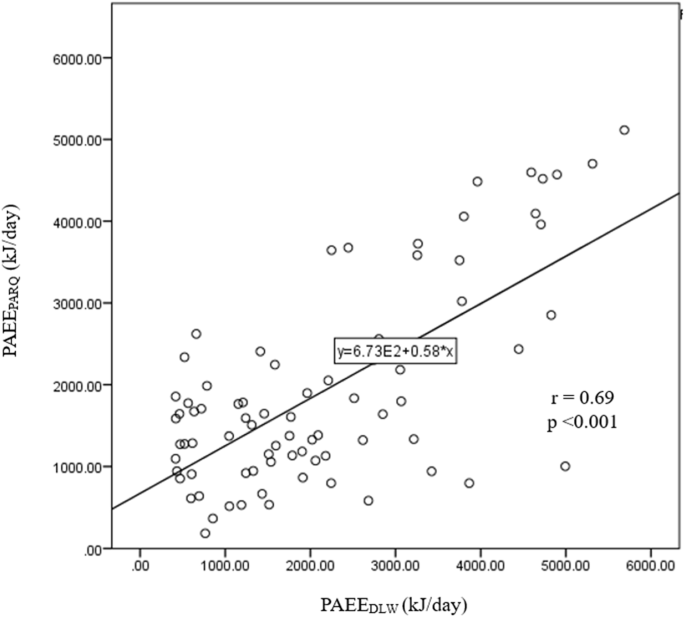
PAEE from the questionnaire (PAEEPAR-Q) was estimated using the method described by Butte et al. [15]. First, total minutes per week was calculated for each activity (minutes/week) and this was multiplied by the corresponding metabolic equivalent value (MET) for the activity from the Youth Compendium of Physical Activities (YCPA) to calculate the MET minutes/week per activity [15]. Then using predicted BMR [12], energy cost (kJ/day) was calculated.
Physical activity log
The physical activity log was adapted from the Bouchard activity diary [16]. Physical activity data were recorded on three days (two weekdays and one weekend day) with each hour divided into 15-minute time periods. Experts including sports medicine consultants, paediatricians, and physical education teachers scrutinized the wording and the content of the log and it was pretested before administering to the study participants on Day 1 of the study. Both children and their parents were instructed on how to complete and monitor the log. Participants were requested to complete the log on any two ‘regular’ weekdays and one ‘regular’ weekend day within the DLW study period [16] and to record activities over the course of the day as they occurred. They were specifically advised to select typical days that reflected their normal routine activities. Completed activity logs were collected on the last post-dose urine sample collection day (Day 10). Energy expenditure from the physical activity log (PAEEPALog) was estimated by the same method as described above to calculate the PAEEPAR-Q.
Statistical analyses
Of the 96 children, four were eliminated as their post-dose urine sample enrichments, as determined by IRMS, were lower than the baseline enrichment for 2H and 18O. Five participants were excluded as the urine sample collection for the DLW protocol was not completed. Eight more participants’ findings were eliminated from the study due to the identification of those values as outliers (>±3 standard deviations from the mean in each data column). Hence, the final sample consisted of 79 children. The information regarding the data-cleaning procedure is published elsewhere [7]. Data analysis was carried out using the SPSS statistics software (version 23.0), and the Kolmogorov-Smirnov test was used to assess the normality of data. Data are presented as mean and standard deviation (SD).
Pearson’s correlation coefficient was used to assess the association between energy expenditure values obtained from the criterion method (TEEDLW and PAEEDLW) and physical activity values obtained from the PAR-Q and activity log (PAEEPAR-Q and PAEEPALOG). Paired sample t-test was used to compare the energy expenditure values obtained from the criterion method with questionnaire and activity log. The Bland–Altman technique of assessing agreement between methods [17] was used to assess the agreement of PAEE estimated from the criterion method with the PAEE from the questionnaire and activity log. In this method, differences between the PAEEDLW and PAEEPAR-Q or PAEEPALOG (y-axis) were plotted against the average of PAEEDLW and PAEEPAR-Q or PAEEPALOG (x-axis). Upper and lower 95% agreement limits were calculated as mean bias ± 1.96 x standard deviations [17]. The relationship between the differences of the measurements and the average of the measurements was evaluated by simple linear regression analyses.
link

:max_bytes(150000):strip_icc()/A-Physical-Therapist-Shares-the-Most-Underrated-Physical-Activity-94666d193c98412ca90ffbcc23339f90.jpg "Experts Say This Exercise Is the Most Underrated")