


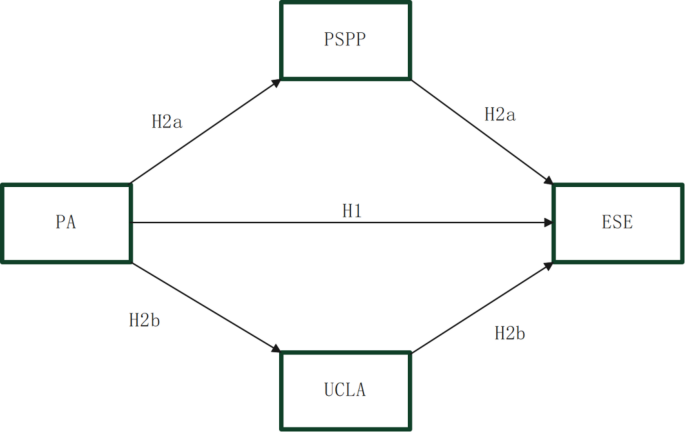
The present study examined the mediating effects of loneliness and body image on the relationship between physical activity and exercise self-efficacy through parallel mediation analysis. Results demonstrated a statistically significant direct positive association between physical activity and exercise self-efficacy, consistent with prior empirical evidence and thus supporting Hypothesis 1a (H1a). Furthermore, the analysis revealed significant dual mediation pathways through loneliness and body image, underscoring the critical intermediary roles of these variables. These findings substantiate Hypotheses 2 and 3 (H2, H3).
This study found a significant direct positive relationship between physical activity and exercise self-efficacy, indicating that individuals with higher physical activity levels exhibit stronger exercise self-efficacy. This finding is consistent with previous research29. Through regular physical activity (e.g., completing a running programme or strength training), individuals accumulate “success stories” that directly increase their confidence in their physical abilities, which also increases exercise self-efficacy. Regular physical activity directly improves individuals’ fitness levels. When people experience improvements in cardiorespiratory fitness, muscle strength, and endurance through exercise, they have more confidence in their ability to sustain and complete a variety of physical activities, which increases their exercise self-efficacy5. Another study of patients with spinal cord injuries revealed that participation in a tele-exercise intervention significantly increased patients’ exercise self-efficacy30. In addition, people with high exercise self-efficacy are predicted to be more physically active. This has been validated in a study of physical activity and self-efficacy in older adults, where self-efficacy in the early years (Year 1) significantly predicted physical activity levels in the later years (Year 5)31. This means that exercise self-efficacy and physical activity form a positive cycle in which individuals who are more physically active are more athletic. More athletic individuals tend to have greater exercise self-efficacy and are therefore more inclined to exercise and increase their physical activity. In this study, exercise self-efficacy was confirmed as an important mediating variable that linked exercise capacity and physical activity. Nonetheless, the relationship between exercise self-efficacy and physical activity is complex and variable, which makes it important to examine the connection between these two factors. Additionally, sex and age may influence the relationship between physical activity and exercise self-efficacy. Therefore, when examining the direct impact of physical activity on exercise self-efficacy, it is essential to acknowledge that this influence may not be immediately apparent due to the interference of many accompanying factors. Considering this, universities should consider the characteristics of different types of physical activities when adopting them as strategies to increase exercise self-efficacy. This will help to identify more appropriate starting points and methods for research, which will more effectively promote the improvement of exercise self-efficacy.
The study establishes a significant association between physical activity and exercise self-efficacy, while further revealing body image as a mediator influencing exercise self-efficacy. This finding highlights the importance of cultivating body awareness. In the overall mediation analysis, the mediating effect of body image was found to be particularly significant: body image was significantly and positively correlated with exercise self-efficacy. This finding is consistent with previous research. Research has shown that when individuals have a positive view of their bodies, they are more likely to believe in their ability to improve their physical state and achieve their health goals32. Bandura suggested that individuals’ beliefs about their ability to complete a task successfully (i.e., self-efficacy) influence their behavioural choices and level of persistence33. A positive body image can increase self-confidence and self-esteem, which in turn can increase self-efficacy. When individuals are satisfied with their body size and fitness, they are more likely to participate in physical activities and believe that they can accomplish these tasks34. At the same time, higher levels of exercise self-efficacy enable individuals to overcome the challenges of an exercise programme, thereby influencing their physical self-perceptions35,36. In the present study, we found that the associations between body image and age or sex were not significant. This differs from the results of previous studies. Silva et al. (2018) noted that body image is negatively correlated with sex, with female participants exhibiting higher rates of eating disorders and greater concerns about body image37. This may be related to the characteristics of the study sample. Our study population consisted of a group of college students with a relatively narrow age range and similar educational backgrounds and upbringings, which may have limited the manifestation of age and sex differences in body image. In addition, this study revealed the positive effects of physical activity on exercise self-efficacy, a process primarily realized through improved body image. This finding provides important theoretical support for the design and implementation of health promotion interventions. Encouraging individuals to participate in physical activity can improve physical function and health status directly and can improve exercise self-efficacy indirectly through enhanced body image, which can encourage individuals to participate in health behaviours more actively, forming a virtuous cycle37,38.
The present study reveals the complex associations among physical activity, loneliness, and exercise self-efficacy and elucidates the mechanisms of action through path analysis of the mediation model. These findings suggest that loneliness not only negatively predicts exercise self-efficacy but also plays a significant mediating role in the relationship between physical activity and exercise self-efficacy. Specifically, physical activity can indirectly improve exercise self-efficacy by reducing loneliness. These findings suggest that loneliness plays a significant role in the relationship between physical activity and exercise self-efficacy. Its mediating effect indicates that increased physical activity not only directly improves physical functioning and health status but also significantly increases individuals’ exercise self-efficacy by reducing loneliness. This finding offers new insights into the mental health benefits of physical activity and highlights the importance of considering individuals’ psychological state when promoting physical activity.
Our study further demonstrates the interrelationship among physical activity, exercise self-efficacy, and loneliness. Although the mediating effect of loneliness in this investigation was relatively small yet statistically significant, extant research has established a significant negative association between physical activity and loneliness, indicating that higher levels of physical activity correspond to lower levels of loneliness39,40. Additionally, some studies have shown that the relationship between loneliness and physical activity is moderated by affective valence (AV). One study reported that physical activity was more strongly associated with reduced loneliness for individuals with higher affective valence. In contrast, individuals with lower affective valence may experience a weaker or even negative relationship between physical activity and loneliness39. This moderating effect may partially explain the small mediating impact of loneliness in the present study. However, despite the small effect size, the negative influence of loneliness remained, and this influence had a significant negative impact on exercise self-efficacy. Specifically, individuals with higher levels of loneliness tend to have fewer opportunities to engage in physical activity, often due to factors such as a lack of athletic peers or weaker socialization skills, which results in lower levels of physical activity. This lower level of physical activity further undermines their confidence in their athletic ability, thereby reducing exercise self-efficacy. Conversely, individuals with lower levels of exercise self-efficacy are more likely to be less physically active, creating a vicious cycle in which loneliness leads to lower levels of physical activity, which in turn lowers exercise self-efficacy; low levels of exercise self-efficacy inhibit participation in physical activity, ultimately exacerbating loneliness. In addition, the present study reveals that loneliness is related to age, which is like previous research that suggests a nonlinear relationship between loneliness and age, such as a U-shaped relationship whereby adolescents and older adults are more likely to feel lonely. Middle-aged adults (aged 30–60 years) are generally the least lonely41. In summary, this study highlights the complex role of loneliness in the relationship between physical activity and exercise self-efficacy. Although previous research has recognized the impact of loneliness on sports participation, its mediating role between physical activity and exercise self-efficacy has not been explored. The findings of this study suggest that when interventions are designed, it is important to focus not only on physical activity but also on individuals’ emotional states and social environments to break this vicious cycle and improve overall physical and mental health.
In this study, loneliness and body image served as parallel mediators between physical activity and exercise self-efficacy. The mediating effect of body image was more pronounced, which aligns with H3. In contrast, the impact of loneliness was less apparent. This difference may stem from the distinct pathways through which they operate: the modulation of loneliness often involves psychological factors, making it more subjective42, whereas individuals with moderate levels of loneliness might also engage in exercise spontaneously. Conversely, the influence of body image is more direct and evident. For example, individuals may avoid physical activity due to a lack of confidence in their body shape, which in turn affects their exercise self-efficacy43. Consequently, the mediating effect of loneliness is relatively lower. Although the impact of loneliness was minor in this study, it still poses potential negative risks.
In the process of improving exercise self-efficacy through physical activity, it is important to focus on the positive role of body image and remain vigilant about the vicious cycle that loneliness might trigger, especially its potential threat to mental health, such as tendencies towards depression. When designing intervention measures, it is essential to foster a positive body image and create a supportive social environment to improve individuals’ exercise self-efficacy and mental health levels comprehensively.
Research limitations and future perspectives
While this study provides valuable insights into the underlying mechanisms linking physical activity and exercise self-efficacy among university students, several limitations warrant attention in future research. First, the cross-sectional design employed here can only reveal correlations between variables and cannot infer causality. Although we examined the relationships among physical activity, loneliness, body image, and exercise self-efficacy using mediation models, the causal direction of these relationships remains undetermined. Future research should adopt longitudinal designs, incorporating multi-wave measurements and long-term follow-ups, to verify causal links between the variables. Second, constrained by practical limitations, the measurement of physical activity relied on self-report questionnaires (e.g., PARS-3), which are susceptible to recall bias. Future studies should employ objective tools, such as accelerometers, to enhance measurement accuracy and reliability. Moreover, the study sample comprised a relatively homogeneous university student population with a limited age range and diversity. This homogeneity may obscure potential moderating effects of demographic variables such as age and gender. Concurrently, the research focused solely on loneliness and body image as mediating variables, neglecting other potential mediating factors such as exercise motivation, emotion regulation ability, exercise identity, anxiety, and psychological resilience. This narrow scope limits the generalizability of the findings. Future research should refine study designs, measurement instruments, and analytical approaches to provide a more comprehensive and in-depth understanding of the complex interplay inherent in this relationship.
link